Non-conventional Microfluidics
TL,DR: Conventional microfluidic systems are useful, but a bit dry for my taste - so I try doing non-conventional things to and with them using hydrogels, chemical signalling, and sometimes a knife.
Microfluidics is more-or-less plumbing, but for scientists, and at the small scale. You guide small volumes of fluid (microlitres) through tiny channels at the micrometre scale. At these dimensions, flow behaves oddly: flow becomes laminar, mixing becomes hard. At the same time, you can do some really fun stuff: reactions in-flow with very low volumes, specific placing of compounds or cells, etc.. People dream of labs-on-a-chip: building entire laboratories onto postage-stamp-sized microfluidic chips, allowing (for instance) quick medical diagnostics, with only small amounts of blood or reagent.
Microfluidics is a great technique. It got a bad rep for a little bit after all the Theranos business1), but it can genuinely be a great tool. In the lab, people use microfluidics in various devices (GPC, HPLC), to accurately and consistently create small objects like emulsion droplets, and in random other stuff you would maybe not expect, for instance to control soft robots. Unfortunately, true labs-on-a-chip are currently more of a protocol-on-a-chip: someone in a lab can make decisions during an experiment, change the order of steps, change all kinds of things. Microfluidic chips are not very flexible. They can do very specific tasks with nice reproducibility, but any change to the protocol requires a new (and expensive!) chip. A scientist that wants to convert his labwork to a microfluidic chip often cannot, because the lack of flexiblity in microfluidics.
Can we improve this situation? People working on so-called “reconfigurable microfluidics” try to do so. Instead of making fixed channels and paths for the liquid to flow through, they build systems where liquid flows on an adaptable path. The path can be adapted either because of a decision a scientist makes based on live data from the chip, or even autonomously depending on the conditions in the chemicals flowing through the chip.
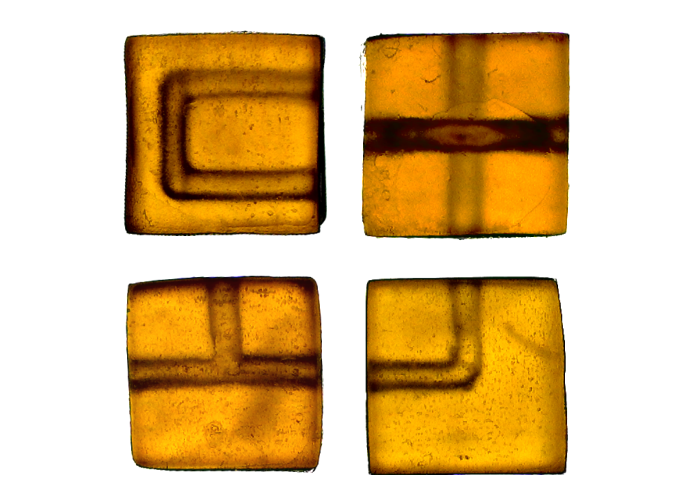
I sort of rolled into this world of small flows without realizing. I have created a few hydrogel-based systems that can be 3D-printed, and adapted later, on the fly. I will not go into details too much, but in some systems, reconfiguration can occur by simply mechanically cutting chips and gluing them back at other places, and in others, printed objects disappear when a chemical trigger arrives via the microfluidic channel. Finally, I also look into vascular networks; making a vascular-like system in materials to deliver or collect molecules, similar to the one in our bodies.
All-in-all, conventional microfluidic systems are useful, but a bit dry for my taste - so I try doing non-conventional things to and with them using hydrogels, chemical signalling, and sometimes a knife.