Life-like Intelligent Materials & Systems
TL,DR: I try to convince dead chemical and physical systems to show a little intelligence and life-like behaviour - and make use of that.
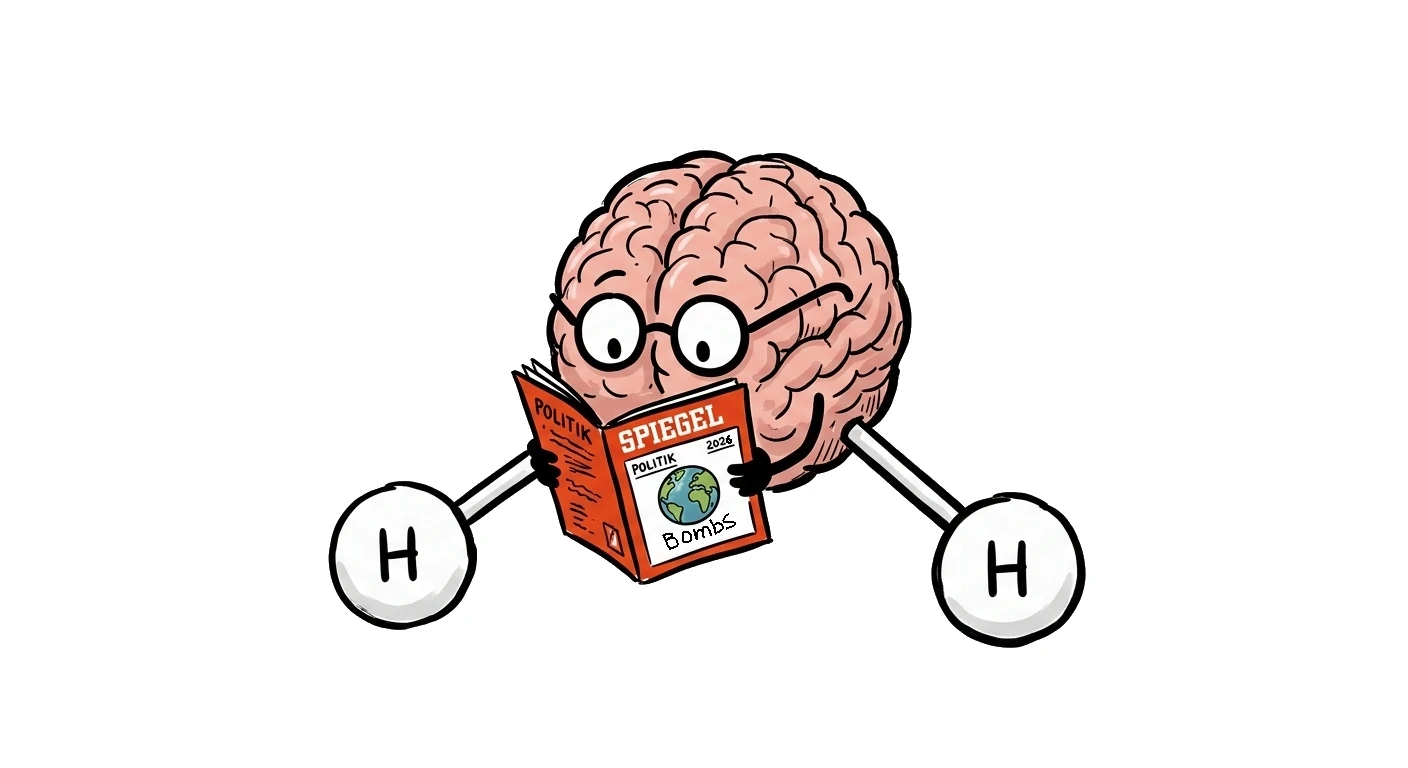
What is intelligence? It is not an easy word to define. It is something that feels obvious, but the grey area is surprisingly large1). Clearly, humans are intelligent. And probably most mammals are intelligent as well. Can simpler things also be intelligent? I think so! Spiders build complex traps, bees have a (sort-of) language through dance, and they even play with things2). I would call that intelligent. So how about even simpler things, like moulds or bacteria? Slime moulds are actually quite famous for being able to solve mazes 3) and can be used to model human supply networks 4). Even bacteria show complex behaviour: they can hunt, sniff out dangers, protect against cold, and even work together if times are tough (they decide this in a democracy-like quorum-sensing mechanism5)).
You may not agree with this definition of intelligence, and I would not claim a bacteria is very intelligent. But it is definitely more intelligent than the average rock! 6) The question I then have: how do these single-celled organisms think?7) They have no nerves or brains; they don't have a central 'processor'. Instead, they do all of their decision-making through chemistry.
Relatively simple reactions between DNA, RNA, proteins, and other bio-molecules in the cell are somehow chained together into a system that can sense the complex outside world, process this information, and react to it. Although the individual reactions are (typically) not that complicated from a chemistry perspective, the overall network is extremely complex and too hard to really understand for us right now8). Some elements, like positive and negative feedback loops, can be extracted from the mess, but how it all works as a whole is very hard to say. Of course, the cell does not have to worry about all of this. Evolution cares little about complexities and happily constructs massive chemical reaction networks to make decisions.

So, cells do not use networks of nerves like we do. Instead, they implement the networks in chemistry. The basis of the computations is the same. It is just the medium in which it takes place that is different. (Neural networks used by e.g. Large Language Models are another example of this - also networks, but not of nerves, but 'nodes' with functions in the computer.) That then leads to my real question: can we mimic this in the lab? Since chemistry is not really fundamentally alive or dead, there is no reason why an artificial network of chemical reactions (or any other networked physical process, really) would not be able to be intelligent in some way, meaning that it can make decisions based on its surroundings.
As it turns out, yes!, you can mimic this in the lab. So-called reservoir computing, a specific architecture for these networks, can be used to make impressive calculations even from surprisingly simple systems. My favourite example uses interfering waves in a bucket of water9). More complex, and more powerful are systems using chemical reactions directly10). Coupled oscillating reactions can be convinced to do object recognition11). And my own recent work shows that in-flow reaction networks influenced by the thing they flow trough can be used for signal processing12). All very cool! For a few reasons:
- It is kind of weird and unexpected (to me at least) that chemistry can actually do computations.
- It gives us a bit of insight into how early life must have developed: it is a fundamental and universal part of life that decisions about the environment need to be made (to find food, shelter, to react to changing environmental conditions, …), even for the most simple living things. And it must have started with some funny chemistry.
So, that is what I am working on: I try to convince dead chemical and physical systems to show a little intelligence and life-like behaviour - and make use of that.